


Page 331 - CAVIAR GUIDE
P. 331
LEGAL TRADE VS. ILLEGAL TRADE


            Annually, over 1 million CITES permits and
            certificates are issued by Parties covering
            international wildlife trade estimated to be worth
            billions of dollars and to include hundreds of
            millions of plant and animal specimens. The trade
            is diverse, ranging from live animals and plants
            to a vast array of wildlife products derived from
            them, including food products, exotic leather
            goods, wooden musical instruments, timber, tourist
            souvenirs, cosmetics and medicines.

            Effectively regulating trade in wildlife products
            has great benefits for people, such as ensuring
            sustainable livelihoods, and protecting ecosystems
            and the vital services they provide.


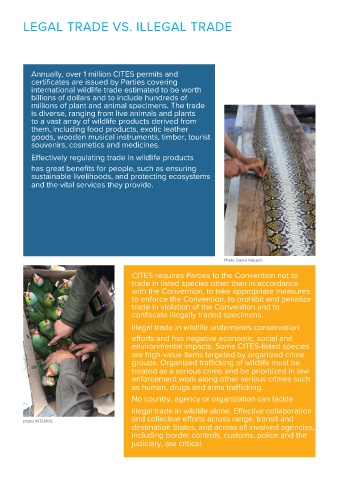
                                                                                Photo: Daniel Natusch


                                               CITES requires Parties to the Convention not to
                                               trade in listed species other than in accordance
                                               with the Convention, to take appropriate measures
                                               to enforce the Convention, to prohibit and penalize
                                               trade in violation of the Convention and to
                                               confiscate illegally traded specimens.

                                               Illegal trade in wildlife undermines conservation

                                               efforts and has negative economic, social and
                                               environmental impacts. Some CITES-listed species
                                               are high-value items targeted by organized crime
                                               groups. Organized trafficking of wildlife must be
                                               treated as a serious crime and be prioritized in law
                                               enforcement work along other serious crimes such
                                               as human, drugs and arms trafficking.

                                               No country, agency or organization can tackle

                                               illegal trade in wildlife alone. Effective collaboration
                                               and collective efforts across range, transit and
         photo: INTERPOL
                                               destination States, and across all involved agencies,
                                               including border controls, customs, police and the
                                               judiciary, are critical.

