


Page 325 - CAVIAR GUIDE
P. 325
rules.Consumers will also benefit from these new labelling requirements as they will
                                           allow them to verify the legality of caviar when making their purchasing choices.


                                           STURGEON PRODUCTS AFFECTED
    Credit Sergey Kuznetsov  :             All caviar from all species of sturgeon and paddlefish are covered by CITES.Common


                                           names and grades of caviar include:Beluga,asetra,osetra,sevruga,kaluga,hackleback,
                                           paddlefish,shovel-nosed  sturgeon,American  sturgeon,American  black  and  sterlet.
                                           CITES covers trade in all specimens,parts and products (derivatives) of sturgeons and
                                           paddlefish,including  caviar,meat,leather,live  fish,fertilized  eggs,cartilage  and  fish
                                           glue.Pressed caviar,pasteurized caviar and the most commonly exported caviar, lightly
                                           salted  "malossol",are  also  covered  by  CITES.Any  international  shipments  of  these
                                           products must therefore always be accompanied by the relevant CITES permits.For
                                           further information on CITES permits,contact the CITES Management Authority in your
                                           country or visit the CITES Secretariat website (at www.cites.org).


                                           The CITES labelling requirements currently apply only to caviar.Roe from non- CITES-
                                           listed fish,including products often referred to as "caviar substitutes",are not regulated
                                           by  CITES.In  several  countries  (and  in  the  EU),the  use  of  the  word  "caviar"  is
                                           restricted,by law,to roe of sturgeon and paddlefish.


                                           LABELLING REQUIREMENTS


                                           Under  the  CITES  requirements  for  caviar  labelling,all  primary  containers  of  caviar
                                           must  have  a  non-reusable  label,which  means  that  the  label  cannot  be  removed
                                           without  being  damaged.This  includes  tins,boxes,jars  or  any  other  container  into
                                           which  caviar  is  directly  packed,regardless  of  their  size  or  whether  their  shipping
                                           destination is domestic or international.The labelling requirements apply to all caviar
                                           whether  it  is  produced  for  commercial  or  non-commercial  purposes  and  sold
                                           internationally or on the domestic market.The non-reusable label is to be affixed by
                                           a processing or re-packaging plant.The label must either seal the container or the
                                           caviar  must  be  packaged  in  such  a  manner  as  to  permit  visual  evidence  of  any
                                           opening of the container.The information that appears on the label must be included
                                           in or attached to the CITES export permit.There are two types of labels—the type
                                           used depends on whether the caviar is packed by a processing plant in the country of
                                           origin or re-packaged in another country.


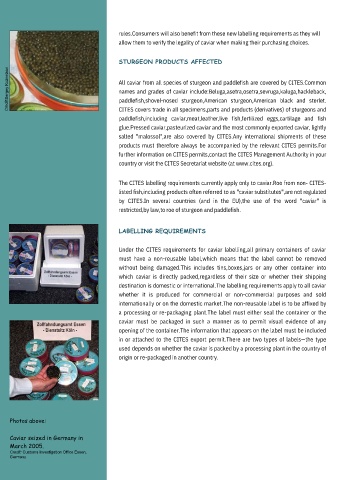
    Photos above:


    Caviar seized in Germany in
    March 2005.
    Credit:   Customs Investigation Office Essen,
    Germany

